
 e-Tafakna
 Tunisia
n law in Arabic and French, with case law, searched in the language of your choice. Every answer cites the article it rests on.
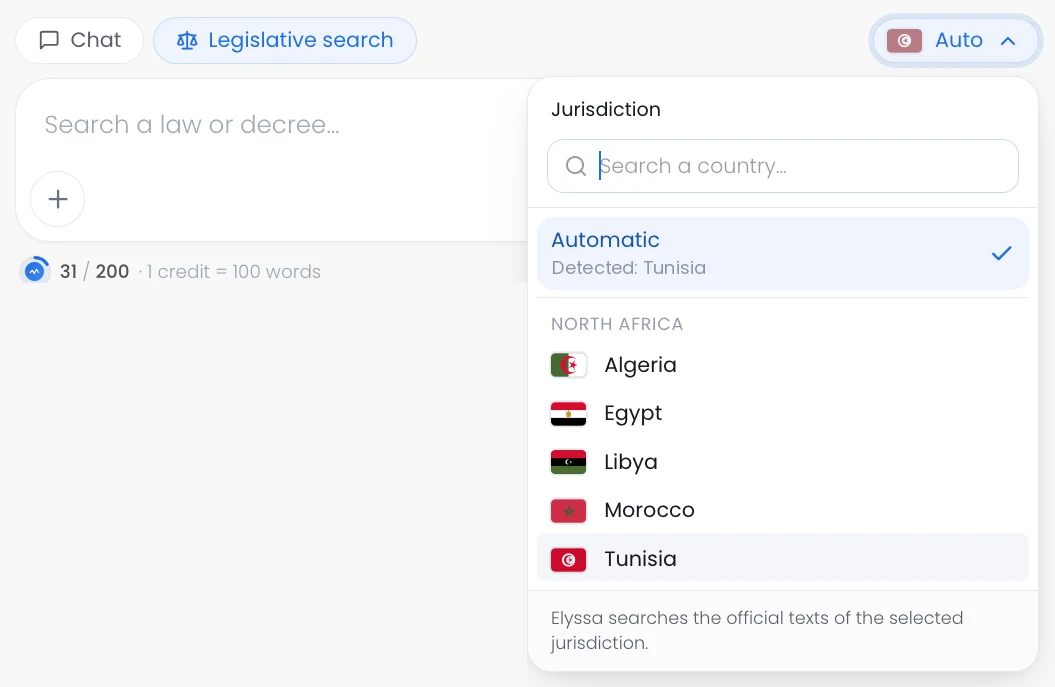
Elyssa searches the official texts of the selected jurisdiction.
Code of Obligations and Contracts (1906)
Labour Code (Law 66-27), reformed by Law 2025-9
Commercial Companies Code (Law 2000-93), Commercial Code
Tax Rights and Procedures Code, personal and corporate income tax code, finance laws
Law 2016-71 on investment
Law 2000-83 on electronic exchanges and commerce
Organic Law 2004-63
The 1906 code still governs how contracts are formed, performed and annulled.
Law 2025-9 limits fixed-term contracts to exceptional cases and bans labour subcontracting. Probation is capped at six months, renewable once.
Laws are published in the Official Gazette (JORT) in Arabic; the French version is published for information only (Law 93-64).
Law 2000-83 recognises electronic signatures; qualified signatures rely on TunTrust certificates.
In Legislative search mode, Elyssa searches the country's official texts and cites the article behind its answer.
Any type of contract under the country's law, in the language of your choice: employment, services, confidentiality, lease, shareholders' agreement.
Risks, missing clauses and a compliance score against the country's law, with Elyssa.
Review a contractSince January 2026, electronic invoicing has been extended to all VAT-registered service providers.
Source: TuniscopeOpen-ended contracts become the rule, fixed-term contracts are limited to specific cases, and labour subcontracting is prohibited and subject to criminal penalties.
Source: DLA PiperYes. It cites the texts and draws on decisions of the Tunisian courts.
In Arabic, French or English. The article cited with every answer.
Commercial Code, Law 2024-41 on cheques
Decisions of the Tunisian courts
No sign-up needed.
Sign your contracts with a TunTrust, Digigo or Mobile ID certificate.
Discover e-signatureSet up your SARL or SUARL entirely online.
Set up my companySince 2 February 2025, cheques must be crossed, are capped at 30,000 dinars and are verified in real time through the TuniChèque platform.
Source: WebdoData from the MENA Legal Observatory, checked in October 2026. See the Observatory
 Algeria
 Libya
 Morocco
 France